
1. I have never, ever eaten at Taco Bell.
2. I once played Bach's Inventio 11 while single handedly chalking a pool cue.
3. I often frolic.
4. I once led a large troupe of amazonian refugee children safely through a hoard of poisonous frogs.
5. I aspire to be the first person to read the entire published works of Hilaire Belloc while unicycling through the canadian rockies.
6. I have a patent pending for a more energy efficient grandfather clock.
7. I am an abstract jazz pianist and an expert asbestos inspector.
8. I can hurl jello at non-moving objects with uncanny precision.
9. I have three times escaped the clutches of evil pastafarians.
10. On Tuesday evenings, after work, I repair large hadron colliders.
11. Buddhist monks resent me.
12. I once escaped from the creation museum using only a food processer and six pages from 'Origin of the Species'.
13. I frequently beat Tiger Woods golf score, and in far fewer holes.
14. I have been known to inspire widespread gloom.
15. I prefer solving Soduko puzzles using roman numerals.
16. I have performed covert operations for the United States Chess Federation.
17. When bored, I dabble in quantum chromodynamics.
18. I am the subject of numerous autobiographies.
19. When I do eat, I eat in a hammock.
20. I can do seven minute abs in under four minutes.
21. I have 27 facebook accounts, but only 23 friends.
22. Fashion critics swoon over my latest line of academic regalia evening wear.
23. I do macrame, I drivel, I have poor circulation in my feet.
24. The laws of physics do not apply to me.
25. I resent the implication, Mr. Attorney General.
Saturday, February 21, 2009
Sunday, December 30, 2007
The New Dogmatism
Atheism’s Wrong Turn :: Sam Harris
In this excellent commentary on the "New Atheism" crusade, New Republic writer Damon Linker observes the danger of the dogmatic position taken by the so-called Four Horsemen of the new atheist movement. Citing their open hostility to all things religious, Linker likens the danger of their dogma to the destructiveness of fundamentalist religious faith:
In this excellent commentary on the "New Atheism" crusade, New Republic writer Damon Linker observes the danger of the dogmatic position taken by the so-called Four Horsemen of the new atheist movement. Citing their open hostility to all things religious, Linker likens the danger of their dogma to the destructiveness of fundamentalist religious faith:
The last thing America needs is a war of attrition between two mutually exclusive, absolute systems of belief. Yet this is precisely what the new atheists appear to crave. The task for the rest of us--committed to neither dogmatic faith nor dogmatic doubt--is to make certain that combatants on both sides of the theological divide fail to get their destructive way.Read the entire article
Friday, December 28, 2007
D'Scrooga on Christmas
Bah.
I came across Dinesh D'Souza's Christmas blog "How Atheists Celebrate Christmas" today. I have to say I am disappointed in this conservative-turned-apologist on a number of fronts.
I had the opportunity to hear D'Souza speak a few weeks ago, and I actually briefly met him to obtain an autograph on his recent book "What's So Great About Christianity". At the time, I had only recently learned of D'Souza after watching his debate with atheist and author Christopher Hitchens. I have watched many of Hitchens' debates with Christian apologists (as well as those of Richard Dawkins and Sam Harris), and I found D'Souza to be one of his better opponents. He seemed very cogent in his faith worldview, and responded with civility, good humor, and intelligence. I felt the same when I heard him speak. Having read his Christmas blog, however, I wonder now what sets him apart from his adversaries.
In his blog, D'Souza wonders out loud how Atheists celebrate Christmas. This is a puzzling question from the start, as Christmas as celebrated in America is largely a secular, commercial holiday. No doubt this troubles D'Souza as it does so many other believers who long for a long-lost day when the religious meaning of Christmas was a towering aiguille (if ever such a day existed). Having no one to blame for this except our consumerist culture, he has found a surrogate in the "atheists", and what better atheist than the notorious Christopher Hitchens of "God is Not Great" fame?
In his attempts at good-humored cynicism, one wonders whether D'Souza is attempting to emulate Ann Coulter, or even Hitchens himself (he fails on both counts). Here's the first example:
As for D'Souza's incursion against Monty Python, well that is something completely different. I mean, nobody expects the Spanish Inquisition...
I came across Dinesh D'Souza's Christmas blog "How Atheists Celebrate Christmas" today. I have to say I am disappointed in this conservative-turned-apologist on a number of fronts.
I had the opportunity to hear D'Souza speak a few weeks ago, and I actually briefly met him to obtain an autograph on his recent book "What's So Great About Christianity". At the time, I had only recently learned of D'Souza after watching his debate with atheist and author Christopher Hitchens. I have watched many of Hitchens' debates with Christian apologists (as well as those of Richard Dawkins and Sam Harris), and I found D'Souza to be one of his better opponents. He seemed very cogent in his faith worldview, and responded with civility, good humor, and intelligence. I felt the same when I heard him speak. Having read his Christmas blog, however, I wonder now what sets him apart from his adversaries.
In his blog, D'Souza wonders out loud how Atheists celebrate Christmas. This is a puzzling question from the start, as Christmas as celebrated in America is largely a secular, commercial holiday. No doubt this troubles D'Souza as it does so many other believers who long for a long-lost day when the religious meaning of Christmas was a towering aiguille (if ever such a day existed). Having no one to blame for this except our consumerist culture, he has found a surrogate in the "atheists", and what better atheist than the notorious Christopher Hitchens of "God is Not Great" fame?
In his attempts at good-humored cynicism, one wonders whether D'Souza is attempting to emulate Ann Coulter, or even Hitchens himself (he fails on both counts). Here's the first example:
Then there's Christopher Hitchens, whom I've known over the years and like just as much. Hitchens, alas, seems to be letting his atheism get to him. First, the poor man is never seen without a drink. ... you'll see that Hitchens reaches for his glass with the same alacrity that fundamentalists reach for the Bible.This is an unwarranted ad hominum attack. While it may be true that Hitchens is never seen to be far from his glass, what is the point? Is this the worst he can say of Hitchens character, that he may in fact have a substance abuse issue? I laughed out loud at the irony of his self-betraying reference to the fundamentalist needing his bible in the same way that an alcoholic needs his drink. But wait - there's more:
Many libertarians are basically conservatives who are either gay or druggies or people who generally find the conservative moral agenda too restrictive. So they flee from the conservative to the libertarian camp where much wider parameters of personal behavior are embraced. To the sensible idea of political and economic freedom many libertarians add the more controversial principle of moral freedom, the freedom to live however you want as long as you don't harm others. Hitchens, needless to say, is at home in this group.In truth, many libertarians are religious, opposed to substance abuse, accepting of people without regard to sexual orientation, and committed to an ethical lifestyle, the conservative "moral agenda" notwithstanding. Libertarianism, as a political philosophy, prizes individual liberty and personal sovereignty over ones own affairs. This principle is deemed violated if any person or institution (including a government) initiates force against said liberty or exercise thereof. Unfortunately, the religious right (whom D'Souze blithely names as "conservatives") has freely initiated force against personal liberty by promotion of the so-named "moral agenda". In fact, it could be said that libertarians have their own moral agenda, one not based on personal private choices, but rather on those moral issues which threaten the well-being and very existence of mankind. In this sense, Christ himself was very much a libertarian, willing to immerse himself in a culture that the religious right of his day would readily name "immoral" for the cause of promoting a higher moral agenda:
The Spirit of the Sovereign LORD is on me,The third point made by D'Souza is to object to Hitchens' reading at a Christmas Party of a satirical lyric by Tom Lehrer:
because the LORD has anointed me
to preach good news to the poor.
He has sent me to bind up the brokenhearted,
to proclaim freedom for the captives
and release from darkness for the prisoners. (Isaiah 61:1)
Hitchens' contribution to the party was to read an irreverent Christmas ditty by the lyricist Tom Lehrer. Remember Lehrer? He's a bit of a relic, like the Monty Python and the Rocky Horror movies. When I was eighteen and a freshman at Dartmouth I found Lehrer and Monty Python very sophisticated and amusing. Most of us, however, outgrow the juvenile sense of humor that they represent.In order that no one miss the point of Lehrer's lyric, here it is:
Christmas time is here, by golly,It's worth noting that Tom Lehrer's "Christmas Carol" (quoted eyes-closed by a clearly inebriated Hitchens)is a biting commentary on a commercialized christmas holiday, and makes no (repeat, zero) attacks on Christ or Christianity. What it does attack is the consumerist, duplicitous holiday that the American Christmas has become. This is the fodder for Hitchens' cynical attack, and a point of view shared by many people of faith. Kudos to Hitchens for once again speaking the truth. Mysterious ways, indeed.
Disapproval would be folly,
Deck the halls with hunks of holly,
Fill the cup and don't say when.
Kill the turkeys, ducks and chickens,
Mix the punch, drag out the dickens,
Even though the prospect sickens,
Brother, here we go again.
On christmas day you cant get sore,
Your fellow man you must adore,
Theres time to rob him all the more
The other three hundred and sixty-four.
Relations, sparing no expensell
Send some useless old utensil,
Or a matching pen and pencil.
Just the thing I need! how nice!
It doesnt matter how sincere it
Is, nor how heartfelt the spirit,
Sentiment will not endear it,
Whats important is the price.
Hark the herald tribune sings,
Advertising wondrous things.
God rest ye merry, merchants,
May you make the yuletide pay.
Angels we have heard on high
Tell us to go out and buy!
So let the raucous sleigh bells jingle,
Hail our dear old friend kris kringle,
Driving his reindeer across the sky.
Dont stand underneath when they fly by.
As for D'Souza's incursion against Monty Python, well that is something completely different. I mean, nobody expects the Spanish Inquisition...
Altar Boyz in da Hood
Fight breaks out among Bethlehem priests (OneNewsNow.com)
BETHLEHEM, West Bank - Robed Greek Orthodox and Armenian priests went at each other with brooms and stones inside the Church of the Nativity on Thursday as long-standing rivalries erupted in violence during holiday cleaning. Read More
BETHLEHEM, West Bank - Robed Greek Orthodox and Armenian priests went at each other with brooms and stones inside the Church of the Nativity on Thursday as long-standing rivalries erupted in violence during holiday cleaning. Read More
Wednesday, December 12, 2007
A New Apologetic
One source of cognitive dissonance for me in recent years has been my attempt to reconcile the legitimacy of "faith" (specifically American evangelical Christian beliefs based on a plain reading of the Bible), and "reason" (a universal, objective view of physical reality). Volumes can be and have been written on how faith and reason can or cannot or should or should not be taken together. Paleantologist and educator Stephen Jay Gould identified these as non- overlapping magisteria (NOMA):
A new apologetic is needed, one that is relevant to the postmodern, deconstructionist mindset. There are those postmodern Christian apologists such as Caputo and McLaren who are developing new ways of approaching the Christian faith. In the blog A New Kind of Conversation, Myron B. Penner summarizes a new apologetic thus:
(T)he magisterium of science covers the empirical realm: what the Universe is made of (fact) and why does it work in this way (theory). The magisterium of religion extends over questions of ultimate meaning and moral value. These two magisteria do not overlap, nor do they encompass all inquiry (consider, for example, the magisterium of art and the meaning of beauty).This sounds simple enough, but seems insufficient to explain the recent escalation of rhetoric in America over science and religion, theism and atheism, creation and evolution, and church and state. The controversy widens each day as presidential candidates jab each other over doctrinal tenets, the House passes legislation "Protecting" Christmas, and atheist authors top the 2007 best sellers lists. Clearly, if people accepted the NOMA concept, the conflict wouldn't exist to the degree that it does. Among the evangelical christian circles that I have been a part of, NOMA has been only partially embraced. More often, Christians seeking to make a case for their faith will subject it to the purely modern rigors of scientific inquiry, utilizing traditional apologetics to "explain" their doctrines or beliefs. In the face of arguments set forth by atheist rationalists such as Richard Dawkins and Christopher Hitchens, and in light of modern scientific knowledge and scholarship, traditional apologetic arguments (such as those posited by Lee Strobel and even C.S. Lewis), appear impotent.
A new apologetic is needed, one that is relevant to the postmodern, deconstructionist mindset. There are those postmodern Christian apologists such as Caputo and McLaren who are developing new ways of approaching the Christian faith. In the blog A New Kind of Conversation, Myron B. Penner summarizes a new apologetic thus:
"From the Christian point of view, the truth about Christianity cannot be found in modern-styled objectivity. Not only does the essence of Christianity concern the desperate need of humans and God’s gracious (and personal) response to our need, but it also starts with the assumption that human being (including human reason) is unable to save itself. Christian truth presumes to master us, rather than to be mastered by us. In this case, whenever I try to establish the fundamental reasonability of Christianity in modern terms I remove its fundamental “offense” to reason and transform Christianity into something domestic, with nothing other than a cognitive claim on my life. Christianity, however, is a way of being, or what Kierkegaard calls an “actuality”—a way of living with and before God—and not just a cognitive event involving intellectual assent to a set of propositions."I'd be interested in hearing what both religious and secular folks have to add to this conversation.
Friday, December 07, 2007
Christianity as a Global Threat by Brian McLaren
Christianity as a Global Threat | TPMCafe
There’s a lot of talk nearly everywhere these days about the dangers of radical Islam. In some settings, people express similar concerns about Christianity, especially the dangers of a right-wing theocracy here in America. Whether the warnings come from “the new atheists” like Richard Dawkins and Christopher Hitchens or from secular-political voices on the left, the prospective villains are usually described as the Religious Right, Evangelicals, Christian Fundamentalists, and so on.
But largely under the radar, there’s something else going on in the Christian community in the US and world-wide, and it’s a change worth knowing about. Many of us who are involved with this emergence of a new thing would describe it as a deep shift (don’t forget the “f”), even a kind of repentance. Growing numbers of us Christians are ashamed of the ways that we Christians have behaved in recent decades – from Evangelicals backing unjust and unwise wars to Catholics covering up priestly abuse, from Prosperity Gospel televangelists getting rich by ripping off the poor to institutional religious bureaucracies fiddling around in carpet-color-committee meetings while the world is burning, or at least warming dangerously.
Read More
Also read Mike Clawson's critique of McLaren's article on Friendly Atheist
bb
Powered by ScribeFire.
Tuesday, November 13, 2007
Wretched Urgency - from The Internet Monk
The Internet Monk
Wretched Urgency
The Grace of God or Hamsters on a Wheel?
by Michael Spencer
Powered by ScribeFire.
Tuesday, July 10, 2007

Tuesday, January 23, 2007
Thursday, November 23, 2006
The Art of Scripture
It has been many months since I have posted any original essays here. I could make the excuse that I’ve been too busy to write, or that I can’t think of anything to write about. The truth is that like most people, I have had the time to do pretty much whatever I choose, but have chosen to spend it in other ways. As for having topics to write about, there is an abundance of thought running through my mind each day, and I have imagined a hundred blogs in the months that have passed. So why haven’t I written?
And so my journey continues. I’m relieved to find that what I thought was a map for my journey is instead an inspiring, insightful travel guide. I’ve learned that the map is the territory, and a rich and awe-inspiring territory it is.
Wednesday, November 08, 2006
Welcome to Doomsday
Native Forest Council: News: "There are times when what we journalists see and intend to write about dispassionately sends a shiver down the spine, shaking us from our neutrality. This has been happening to me frequently of late as one story after another drives home the fact that the delusional is no longer marginal but has come in from the fringe to influence the seats of power. We are witnessing today a coupling of ideology and theology that threatens our ability to meet the growing ecological crisis. Theology asserts propositions that need not be proven true, while ideologues hold stoutly to a world view despite being contradicted by what is generally accepted as reality. The combination can make it impossible for a democracy to fashion real-world solutions to otherwise intractable challenges. " Read the Article
Sunday, March 19, 2006
Where's a good ringtone when you need one?
 I snapped this photo near Mozart's memorial statue in Vienna, Austria in March 2005. While it's humorously anachronistic, I can't help but think Mozart would have been a techno-junkie if he had lived in our time. And I'm sure he would have had a terrific blog. :-)
Saturday, March 18, 2006
Mercy
When the priests and the priests' priests have closed ranks,
And their flocks and their flocks' flocks have tendered thanks,
Will the unchosen find themselves bereft of hope, of light
Because, unwashed, they dared seek solace in the night?
If so, pray instruct me Lord, what say the Godly's God
To those who soulfully implore He spare the rod?
And their flocks and their flocks' flocks have tendered thanks,
Will the unchosen find themselves bereft of hope, of light
Because, unwashed, they dared seek solace in the night?
If so, pray instruct me Lord, what say the Godly's God
To those who soulfully implore He spare the rod?
--Parkbench
Friday, March 17, 2006
An Irish Blessing
 May those who love us love us
And those that don't love us,
May God turn their hearts.
And if He doesn't turn their hearts,
May he turn their ankles,
So we'll know them by their limping.
Happy St. Patty's Day to All
Sunday, March 12, 2006
The Ethics of Parousia
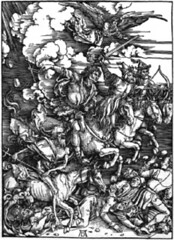
15 For this we declare to you by a word from the Lord, that we who are alive, who are left until the coming of the Lord, will not precede those who have fallen asleep. 16 For the Lord himself will descend from heaven with a cry of command, with the voice of an archangel, and with the sound of the trumpet of God. And the dead in Christ will rise first. 17 Then we who are alive, who are left, will be caught up together with them in the clouds to meet the Lord in the air, and so we will always be with the Lord. 18 Therefore encourage one another with these words.
- Paul's First Letter to the Thessalonians 4:15-18
In Christianity, Parousia means the (Second) Coming of Christ. In the Greek language parousia means "appearance and subsequent presence with" and in the ancient Greco-Roman world it referred to official visits by royalty. It was appropriated by Christians as a specialized term for Jesus' glorious appearance and subsequent presence on earth—primarily his final return at the end of the world (see Wikipedia).
Paul's special revelation regarding the dramatic return of Christ must have been startling to the church at Thessolonica. Although it appears his point in this statement was to provide reassurances for the survivors of those who had died in their faith prior to Christ's return, Paul's parousia provided a glimpse into the apocalyptic worldview that would later be picked up by John as he recorded his spectacular vision in the book of Revelation. There is little doubt that Paul's words were influenced by the words of Jesus himself in referring to his later return, just as John's vision was influenced by (and indeed, lifted word-for-word from) the Old Testament prophets. These eschatological worldviews merged in the early church and carried into the christian era the persistent theme of a conquering messiah whose mission is to purge the world of unbelievers upon his victorious return.
This morning, I sat through the fifth or sixth sermon in a series derived from Paul's first letter to the Thessalonians. The last two messages have focused on the parousia, and these sermons mirrored in many ways the message of a 12-sermon series on the apocalypse which was delivered last summer. I have lately found myself squirming uncomfortably during any message on this topic, a response which in my earlier life would have been attributed to the promptings of the Holy Spirit. What is absent from that equation, however, is a sense that I am somehow on the wrong side of the fence on this issue.
I have long taken exception to many of the eschatological views embraced by the American evangelical church. I can't speak knowledgeably about the church worldwide, or about the orthodox church in general, but the evangelical church in America seems to have codified the anticipated events of the "last days" in a way that trumps reason, stretches the imagination, and extends its hand far beyond the ethical boundaries of today's world. If I had to put a single face on this particular world view (and there are many to choose from) it would be that of Tim LaHaye, author of the Left Behind series of books, videos, and (unbelievably) video games. Dr. LaHaye has successfully capitalized on the apocalyptic world view in much the same way that Hal Lindsay, author of The Late, Great Planet Earth, did in the 1970's. LaHaye's tactics have employed a masterful fear-based marketing scheme, and he undoubtedly owes much of his success, directly or indirectly, to the current war on terror. The events centering around the middle east serve to bolster the claims that Christ's return is at hand: A righteous, Christian nation facing the evil of terrorism abroad; Israel fighting for its very survival against surrounding enemy nations; the occupancy of Jerusalem and the temple by Muslim forces; the increasing globalization of governments and economies; the potential for nuclear annihilation. All the cards are falling into place, and Christ's return is imminent. Or is it?
For a moment, let's assume that the LaHayean vision, appending that of Jesus, Paul, and John, is accurate. What does this mean for Christian believers, and for the world at large? Paul refers to "we who are alive, who are left" as the ones who will be privileged to meet Him in the air. What happens to the rest of the people, under this view, is well described by John in Revelation. To be succinct, God destroys them. All of them. They receive the same fate as the "deceiver", Satan, the "father of lies" who is cast into the lake of fire. Of course, this is only after being inexorably tortured through plague, tribulation, and general madness and mayhem on earth. This, of course, is good for "we who are alive, who are left". It is not so good for those that are not "we". So the question becomes, who are "we", and what is the criteria for inclusion in the "we" group, and its subsequent escape into paradise?
And so we are faced with a truly ethical dilemma. Christ's return is imminent, at which time billions of souls will face cruel torture and eternal damnation by a furious God. Some of us will escape, and others won't. The criteria for escaping the madness consists of "believing" in some way, ostensibly by associating with others who share a common world view. I can't speak for anyone else, but the scenario seems to be inextricably obtuse and generally irreducible. Belief in anything, after all, is really just a particular way of thinking about something to the extent that it will move you to action. As a result, no small part of the criteria for escaping this holocaust depends on what (or how) a person thinks, and with whom they associate. Granted, how a person truly believes will impact how they behave toward other human beings. But it's generally accepted in the evangelical church that a person is saved by grace (belief) alone and not by works (behavior). And so we're really back to a system of evangelism that moves people to respond out of fear, believe in a certain way, and associate with a certain group of like-minded people. All of this, of course, is based on criteria which can be neither known nor measured, but upon which hangs their eternal fate. This I would call a nightmare scenario.
The truth be known, many religions, including Islam, share an apocalyptic world view as recorded in their holy books. One would be wise to observe that the LaHayean version is no less vindictive than the ultimate return of Allah to take final vengeance upon all infidels. What is truly frightening is that their particular apocalyptic vision has moved beyond the "belief" stage, and is well into the "action" stage. Acquisition of nuclear weapons may be all that is needed for Allah to fulfill his prophecies.
What makes me squirm during those sermons is the sense that the church has missed something big here. Our focus on the "Left Behind" fantasies drains resources, creates fear, and causes the church to urgently move people toward "belief" which, in many cases, has little impact upon their ability or willingness to truly impact the world today, here and now.
I'm not really sure what Parousia means, or what it means to say that Christ will return. I know I struggle with Paul's and John's statements in the context of the modern world. I am sure, though, that one of the roles for me as a Christian is to become a truly ethical person: that is to spend my remaining days increasing the joy and abating the suffering of those people whom God brings into my life. Fear does nothing to incubate true ethics, and a false sense of urgency does even less.

Tuesday, January 24, 2006
The End of the Spear
"Ladies and gentlemen, tonight's winner in the category 'Well, what did you expect?' goes to...The End of the Spear....."
I've made a nearly full reversal in my taste of motion pictures in the past several years. Once an avid fan of action-packed, blow-em-up thrillers, bazaar dark comedies, and over the top science fiction films, my tastes have mellowed, matured even, into a preference for more slow-moving, deeply meaningful human dramas of all types. My tolerance for violence in movies is almost at an end, perhaps largely because I have seen the impact of a lifetime of unbridled violence pumped into the eyes and ears of my teenage sons. It's like a switch was thrown in my head that said "enough!".
So I have found myself feeling abandoned, really, by the American film industry. In my way of thinking, the movies I really care to see are few and far between. I want a movie to speak something new and fresh; I don't necessarily need to agree with the movie in theme or subject, but I don't enjoy it unless it resonates with some truth about life that I have never thought about before. These are the movies that I will wait for.
I was happy when the lights dimmed in our church service this past Sunday and a preview for the new film "The End of the Spear" was presented. Being a church in the pietistic / holiness tradition (that is, historically opposed to cinema and other forms of secular entertainment), promotion of film is rare, particularly during worship time. The only other occasion I can recall is when Mel Gibson's "The Passion of the Christ" was being promoted. At any rate, Spear looked intriguing because it appeared to have the qualities that would catch my attention. From what I can tell, the film is the story of a missionary to the Amazon who is killed by tribal natives along with four colleagues. Years later, the missionary’s son returns to the forests and encounters his father’s killer, learning about forgiveness, grace, and acceptance of people who he found to be very different than himself. It is said that the producer of the film is himself a Christian, and that he produced this film with the intent of marketing a mainstream film with a message that would appeal largely to evangelicals. And he would have been right about that last part, were it not for one, small, incorrect assumption.
The Christian workplace where I currently serve was abuzz with excitement about this film. The email bulletin boards were full of messages from people looking for tickets to opening night. Everyone was excited, and I heard many positive reports about the film, it’s strong positive message, and how it was a great contribution to the mainstream entertainment industry. Then the bomb dropped. It seems that someone remembered that the lead actor, Chad Allen, came out in Advocate magazine in 2001 and is openly gay. What was really startling was the uproar this created among evangelicals. It would seem that "gay" is rock while "grace" is mere scissors.
Now lest I begin receiving “love mail” from Christians accusing me of siding with the “gay agenda”, I will first say that I have no intention of arguing here whether an openly gay actor should or should not be “allowed” to work on a film with a overtly Christian theme. The question I really want to ask is, what did the evangelical community expect? Evangelicalism and the entertainment industry have always made strange bedfellows (consider, for example, the 700 Club and the Left Behind series of novels), so it should come as no surprise that not everyone working to produce the film shares in the values portrayed in the film. Why is homosexuality the litmus test for measuring the actor’s worth? I would venture to guess that if Mr. Allen were in fact a straight, albeit promiscuous unmarried man, there would not have been the first whisper about his morality or suitability to play the lead role. Since when does the church hold actors to a higher standard than presidents and priests?
In protest to the Christian community’s bickering over this film, I’m taking my family to see
Sunday, January 22, 2006
A Generation Rejected
I was twice saddened this morning as I attended my church service. Each year on the anniversary of the 1973 Roe V. Wade decision, our church chooses to recognize the loss of a generation of children by solemnly marching people bearing a single rose across the platform, starting with those born in 1973 and progressing to a mother carrying the newest born baby, who drops the last rose in a bassinet. The purpose of this demonstration is to bring to our awareness the “human face” represented by the loss of 40 million children in our nation since 1973. This alone is heartbreaking.
As I pondered this loss, I began to consider the rhetoric in which people on both sides of this issue have engaged. I thought about the litmus test that is now applied to Supreme Court nominees (have we forgotten the No Religious Test clause?); the insistence by the right that Roe v. Wade be overturned; the left’s view of all who consider life sacred to be bigots, or worse, enemies of freedom. And I thought about the 40 million mothers and their families who faced a crisis in their lives and chose the only solution they felt was available to them. And I have just one question: where was the church?
I don't mean this as an indictment of the church, and I mean no disrespect to the thousands of Americans who have fought the good fight in defense of the unborn since 1973. But it is only to say that from the perspective of the average person who watches the evening news, much more energy is expended by opponents of abortion in political activism and national "dialog" than in doing the hard work of immersing themselves in the lives of the marginalized to the extent that they can be agents of change as these difficult decisions are being made. As the groundswell of abortion has gained momentum, have Christians and others who consider life sacred matched this momentum with their counter-momentum of compassion? Or have we accomplish little more than heaping guilt upon the souls of these broken-hearted mothers, while at the same time pouring millions of dollars and hours into fighting political causes? Here's a wake up call: Roe v. wade will likely never be overturned as is hoped by many, and if it were, the church is in no way ready for the crisis that would ensue.
As I have read the gospels in the New Testament, I have never encountered a challenge from Jesus of Nazareth to engage political powers of the day in order to accomplish social change. Jesus and his contemporaries had much more to protest than do Americans. The tyrannical rule of the Roman emporor and his puppet "kings"; the absolute suppression of all dissent and execution of dissenters; crushing taxation carried out by unscrupulous collectors who pocketed fortunes for themselves; and the total absence of political, personal, and religious freedom. Why didn't Jesus speak against these social injustices? Why didn't he organize political action campaigns and raise funds from his followers in order to fight such tyranny? The answer is clear in the gospels: such is not the Kingdom of God. There is little doubt that his followers expected Jesus to advocate political insurrection and social liberation, but such was not his calling and purpose; neither is it ours. Instead, amazingly, Jesus' followers watched as he immersed himself in the lives of the marginalized and disenfranchised. This ministry was spoken of by the prophet Isaiah, who said of Christ:
The Spirit of the Sovereign LORD is on me, because the LORD has anointed me to preach good news to the poor. He has sent me to bind up the brokenhearted, to proclaim freedom for the captives and release from darkness for the prisoners.
Jesus was totally invested in all those who surrounded him, and influenced them in a way that liberated them in the midst of their seemingly hopeless lives. Such is the Kindgom of God.
And so the question remains: what is the role of the Church in the present conflict, and what of the crisis that would ensue if Roe v. Wade were reversed? As for the latter, consider this: for the past fifteen years or so, between 1.3 million and 1.5 million children have lost their lives each year through abortion. During the 1990's, about 120,000 children were adopted each year, or something less than 10% of the children whose lives were ended prior to birth. Even at this rate, a 1997 survey found that 6 in 10 Americans have had a personal experience with adoption (see adoption.com). A reversal of Roe v. Wade, apart from the political firestorm which would continue for decades, would undoubtedly increase tenfold or more the need for compassionate and selfless people willing to care for a rejected generation. Almost every family in America would be impacted. Have we invested our time and resources into the existing adoption infrastructure and counseling services such that this influx would constitue anything less than an unprecedented and unmitigated human and social crisis? Are we demonstrating a committment to mentor our nation's youth, and guide them toward abstinence and healthy relationships such that the need for abortion would be a relic of the past? It would not be overreaching to suggest that the current human and financial resources expended in the fight against abortion are grossly misplaced, and all social support mechanisms (including the church) would be overwhelmed if a reversal were successful.
As for the role of the Church, it is clear. Set aside everything which would hinder compassionate, unfettered ministry to the thousands of women and their families each day who face the worst of all decisions. Support every organization, regardless of affiliation, which will join the cause in providing real choice to these victims of our culture. Mentor our youth and help them see a higher path, and provide them with everything they need to make the right decisions for their lives. Stop sending mixed "moral" messages or supporting those who do. And most importantly, come to know the true spirit of Christ, and administer grace as he would have us administer it. No judgement; no condemnation of wrong; no rejection of those we think have sinned.
The current state of affairs on the pro-life / pro-choice front is tragic. Christians and other people of faith have a responsiblity to care for the wounded and set the captives free, not to continue to wage war. Let's defend the lives of the living as well as the unborn, and preach the good news to the poor: that there is a better choice.
As I pondered this loss, I began to consider the rhetoric in which people on both sides of this issue have engaged. I thought about the litmus test that is now applied to Supreme Court nominees (have we forgotten the No Religious Test clause?); the insistence by the right that Roe v. Wade be overturned; the left’s view of all who consider life sacred to be bigots, or worse, enemies of freedom. And I thought about the 40 million mothers and their families who faced a crisis in their lives and chose the only solution they felt was available to them. And I have just one question: where was the church?
I don't mean this as an indictment of the church, and I mean no disrespect to the thousands of Americans who have fought the good fight in defense of the unborn since 1973. But it is only to say that from the perspective of the average person who watches the evening news, much more energy is expended by opponents of abortion in political activism and national "dialog" than in doing the hard work of immersing themselves in the lives of the marginalized to the extent that they can be agents of change as these difficult decisions are being made. As the groundswell of abortion has gained momentum, have Christians and others who consider life sacred matched this momentum with their counter-momentum of compassion? Or have we accomplish little more than heaping guilt upon the souls of these broken-hearted mothers, while at the same time pouring millions of dollars and hours into fighting political causes? Here's a wake up call: Roe v. wade will likely never be overturned as is hoped by many, and if it were, the church is in no way ready for the crisis that would ensue.
As I have read the gospels in the New Testament, I have never encountered a challenge from Jesus of Nazareth to engage political powers of the day in order to accomplish social change. Jesus and his contemporaries had much more to protest than do Americans. The tyrannical rule of the Roman emporor and his puppet "kings"; the absolute suppression of all dissent and execution of dissenters; crushing taxation carried out by unscrupulous collectors who pocketed fortunes for themselves; and the total absence of political, personal, and religious freedom. Why didn't Jesus speak against these social injustices? Why didn't he organize political action campaigns and raise funds from his followers in order to fight such tyranny? The answer is clear in the gospels: such is not the Kingdom of God. There is little doubt that his followers expected Jesus to advocate political insurrection and social liberation, but such was not his calling and purpose; neither is it ours. Instead, amazingly, Jesus' followers watched as he immersed himself in the lives of the marginalized and disenfranchised. This ministry was spoken of by the prophet Isaiah, who said of Christ:
The Spirit of the Sovereign LORD is on me, because the LORD has anointed me to preach good news to the poor. He has sent me to bind up the brokenhearted, to proclaim freedom for the captives and release from darkness for the prisoners.
Jesus was totally invested in all those who surrounded him, and influenced them in a way that liberated them in the midst of their seemingly hopeless lives. Such is the Kindgom of God.
And so the question remains: what is the role of the Church in the present conflict, and what of the crisis that would ensue if Roe v. Wade were reversed? As for the latter, consider this: for the past fifteen years or so, between 1.3 million and 1.5 million children have lost their lives each year through abortion. During the 1990's, about 120,000 children were adopted each year, or something less than 10% of the children whose lives were ended prior to birth. Even at this rate, a 1997 survey found that 6 in 10 Americans have had a personal experience with adoption (see adoption.com). A reversal of Roe v. Wade, apart from the political firestorm which would continue for decades, would undoubtedly increase tenfold or more the need for compassionate and selfless people willing to care for a rejected generation. Almost every family in America would be impacted. Have we invested our time and resources into the existing adoption infrastructure and counseling services such that this influx would constitue anything less than an unprecedented and unmitigated human and social crisis? Are we demonstrating a committment to mentor our nation's youth, and guide them toward abstinence and healthy relationships such that the need for abortion would be a relic of the past? It would not be overreaching to suggest that the current human and financial resources expended in the fight against abortion are grossly misplaced, and all social support mechanisms (including the church) would be overwhelmed if a reversal were successful.
As for the role of the Church, it is clear. Set aside everything which would hinder compassionate, unfettered ministry to the thousands of women and their families each day who face the worst of all decisions. Support every organization, regardless of affiliation, which will join the cause in providing real choice to these victims of our culture. Mentor our youth and help them see a higher path, and provide them with everything they need to make the right decisions for their lives. Stop sending mixed "moral" messages or supporting those who do. And most importantly, come to know the true spirit of Christ, and administer grace as he would have us administer it. No judgement; no condemnation of wrong; no rejection of those we think have sinned.
The current state of affairs on the pro-life / pro-choice front is tragic. Christians and other people of faith have a responsiblity to care for the wounded and set the captives free, not to continue to wage war. Let's defend the lives of the living as well as the unborn, and preach the good news to the poor: that there is a better choice.
Monday, November 28, 2005
Skeptical Faith Part 1
The majority of my blog readers (two to be exact) recently contacted me to ask what has become of my blog. Honestly, I was embarassed to return to my site, wipe off the thick layer of dust, and discover that it's almost been a year since my last post. I read with some amusement my last post, "Unintelligent Deception", and realized with some discomfiture that it read much like an Ann Coulter* column wannabe, penned by a Pat Robertson intern. OK I admit, it wasn't that bad, but I reviewed it with considerable curiosity, suddenly very aware of how much my views have ... ummm... evolved in the past year. Never lacking introspection, I've pondered these personal changes many times in the past months. Am I losing my faith? Am I what many in my christian denomonation would call a "backsilider"? I can say with some faith (no pun intended) that the answer is no. Far from losing my faith, I've developed a skeptical faith.
Faith is not blind. Faith is not shackled by ignorance. To the contrary, the apostle Paul stated in his letter to the Hebrews:
As I was growing up, this passage was often used to say that when we need to believe something badly enough; when we can't find or understand an explanation, faith substitutes for evidence, for substance. Of course, this would work well in the absence of any evidence which contradicts traditionally held beliefs. But what is a Christian's response when overwhelming evidence does contradict these traditions?
The recent national discourse on Intelligent Design, if I may revisit my earlier topic, presents one such challenge to the Christian creation tradition. Darwin notwithstanding, in earlier days, before geological and genetic evidence surfaced to challenge the traditional view, Christians posessed a certain legitimacy in attributing creation and human origins to the realm of pauline "faith". Indeed, the body of knowledge at the time offered little substance or scientific evidence, and so faith became the evidence of what people knew to be true.
Evidence, though, has a pesky way of tugging on the twine that holds together the neat parcel of the earlier creation traditions. Evidence first of an exceedingly old earth, and then of an observed progression in the development of species began an erosion in the popular Christian view of young earth with its specially created species, "each after their own kind" (Gen 1:12). The twentieth century brought cosmological discovery of an even more ancient universe, and realization of the unfathomable complexity of life contained in the DNA lifecode. It would seem that the earlier "faith" employed by so many previous generations is in danger from such overwhelming contradictory evidence. That is, of course, if one mistakes faith for fantasy.
I have since come to read Paul's definition of faith to be one of humility, and not of arrogance. Faith requires the faithful to accept that "(God's) ways are not your ways" (Is. 55:8). Evidence contradicting my traditional beliefs does not challenge my faith, it frees my faith. Having evidence to explain a little bit more of the mystery of creation provides the substance that my mind needs to understand a little more about God. My faith is liberated, answered in a manner of speaking; freed to help me move on to the next great mystery of an eternal God.
C.S. Lewis once wrote:
Faith is not blind. Faith is not shackled by ignorance. To the contrary, the apostle Paul stated in his letter to the Hebrews:
Now faith is the substance of things hoped for, the evidence of things not seen. (Heb 11:1 KJV)
As I was growing up, this passage was often used to say that when we need to believe something badly enough; when we can't find or understand an explanation, faith substitutes for evidence, for substance. Of course, this would work well in the absence of any evidence which contradicts traditionally held beliefs. But what is a Christian's response when overwhelming evidence does contradict these traditions?
The recent national discourse on Intelligent Design, if I may revisit my earlier topic, presents one such challenge to the Christian creation tradition. Darwin notwithstanding, in earlier days, before geological and genetic evidence surfaced to challenge the traditional view, Christians posessed a certain legitimacy in attributing creation and human origins to the realm of pauline "faith". Indeed, the body of knowledge at the time offered little substance or scientific evidence, and so faith became the evidence of what people knew to be true.
Evidence, though, has a pesky way of tugging on the twine that holds together the neat parcel of the earlier creation traditions. Evidence first of an exceedingly old earth, and then of an observed progression in the development of species began an erosion in the popular Christian view of young earth with its specially created species, "each after their own kind" (Gen 1:12). The twentieth century brought cosmological discovery of an even more ancient universe, and realization of the unfathomable complexity of life contained in the DNA lifecode. It would seem that the earlier "faith" employed by so many previous generations is in danger from such overwhelming contradictory evidence. That is, of course, if one mistakes faith for fantasy.
I have since come to read Paul's definition of faith to be one of humility, and not of arrogance. Faith requires the faithful to accept that "(God's) ways are not your ways" (Is. 55:8). Evidence contradicting my traditional beliefs does not challenge my faith, it frees my faith. Having evidence to explain a little bit more of the mystery of creation provides the substance that my mind needs to understand a little more about God. My faith is liberated, answered in a manner of speaking; freed to help me move on to the next great mystery of an eternal God.
C.S. Lewis once wrote:
We must not encourage in ourselves or others any tendency to work up a subjective state which, if we succeeded, we should describe as "faith"... The state of mind which desperate desire working on a strong imagination can manufacture is not faith in the Christian sense. It is a feat of psychological gymnastics.I'm thankful to be released from my psychological gymnastics. I am grateful to have a mind which is blessed with the capacity to understand an iota more about the wonders of Creator.
Friday, December 10, 2004
Powerlessness
After a being stewed in self pity and anxiousness in life’s crock pot this past week, I find myself savoring my existence in a fresh way tonight. I can’t say anything has really changed; my anxieties are still stacked on my desk at work, hanging from the blueprint racks, and heaped in the hard drives and in-boxes of my computer. My home continues to suffer from a profound lack of order, and I still lack the impetus to take any action to order my world (although I can find the mental energy to conduct hours of mental interrogation with others in my household, indicting them for sloth while absolving myself of the same). I hear the same cacophony that accompanies teenage sons, the same chaotic flurry that I experience almost every moment I live in this house. And yet on this night, I am experiencing a renewed, refreshing peace in the midst of my otherwise mundane domestic existence.
I have become powerless.
My twelve-year-old, Dan, has a friend here tonight. His name is Mikey, and he is an unassuming boy, small for his age and, from every observation, introverted. I reached this conclusion when I met him tonight and did my usual gag of getting his name wrong every time I spoke to him.
“So, Ricky, how do you like the sixth grade?”
Dan rolls his eyes. Mikey isn’t sure if I know his name, but is too polite to correct my conscious error.
“Mitch, it’s time to come downstairs and eat”
More orbs shifting upward. More confused silence from our young guest. I’m sure now that he either thinks I’m a nutjob, or is quietly un-amused.
One thing I have observed though: Dan and Mikey shared our “bonus room” (our family room over the garage), and yet were each engaged in their own activities, Mikey on the PC (watching JibJab flash videos over and over on the internet), and Dan on the Xbox. I encouraged them to turn off the screens and do something fun together. Resistant, blank stares provided only the briefest respite from their digital coma.
Now, two hours later, I’m watching them as they delightfully interact. Fifteen minutes hip-to-hip on the piano, sometimes playing the same song, sometimes not. For a moment, they play Beethoven: Mikey playing the Fifth in the lower register, Dan playing Fur Elise in the upper. It’s surprisingly harmonic. Now its on to some unidentifiable, polyrhythmic dance number, and then on to the great duet stand-by “Heart and Soul”, complete with knuckle solo.
Then it’s off to sword battles, accompanied by exquisitely chatty narratives of fantasy and dragons. They’re both talking at the same time. Floorboards creak; some unknowable item crashes to the floor. It’s off to a card game now, and then to a puzzle. Back to the swords, then on to scrabble (they call it “scabble” because, they say, they can’t find the “R’s”)
This remarkable resurrection of the CRT zombies was spontaneous, and delightful to behold. They, too, have become powerless.
Mike, my sixteen-year-old, although not visited this evening by the teenage angst which often takes residence in whatever room he occupies, still did not wander far from the television or Gamecube. Right now, he’s off to Walmart to buy some high-bulk food (“gotta gain six ponds by tomorrow, Dad….I need to wrestle at 119 ‘cause I think I can take that kid tomorrow”). He also took (GASP) his OWN MONEY to fill up his tank. Maybe he’ll stop by Blockbuster to get that video. This flurry of activity outside our humble domicile is not typical of Mike. But then again, he too has become powerless.
My lovely wife, Diane, went upstairs some time ago to put our bedroom in order. She emerged just now, accompanied by Dan and Herbie (errr...I mean Mikey) with black Glad bags full of clothes for good will. I would help her, but I’ve suddenly felt the return of contentment in my life during this brief moment, and finally found the inspiration to post my first full blog entry. Life is good when you’re powerless.
The electric company says the power may not come back on until midnight. They can leave it off until Monday for all I care – I’m just glad to have my family back.
I have become powerless.
My twelve-year-old, Dan, has a friend here tonight. His name is Mikey, and he is an unassuming boy, small for his age and, from every observation, introverted. I reached this conclusion when I met him tonight and did my usual gag of getting his name wrong every time I spoke to him.
“So, Ricky, how do you like the sixth grade?”
Dan rolls his eyes. Mikey isn’t sure if I know his name, but is too polite to correct my conscious error.
“Mitch, it’s time to come downstairs and eat”
More orbs shifting upward. More confused silence from our young guest. I’m sure now that he either thinks I’m a nutjob, or is quietly un-amused.
One thing I have observed though: Dan and Mikey shared our “bonus room” (our family room over the garage), and yet were each engaged in their own activities, Mikey on the PC (watching JibJab flash videos over and over on the internet), and Dan on the Xbox. I encouraged them to turn off the screens and do something fun together. Resistant, blank stares provided only the briefest respite from their digital coma.
Now, two hours later, I’m watching them as they delightfully interact. Fifteen minutes hip-to-hip on the piano, sometimes playing the same song, sometimes not. For a moment, they play Beethoven: Mikey playing the Fifth in the lower register, Dan playing Fur Elise in the upper. It’s surprisingly harmonic. Now its on to some unidentifiable, polyrhythmic dance number, and then on to the great duet stand-by “Heart and Soul”, complete with knuckle solo.
Then it’s off to sword battles, accompanied by exquisitely chatty narratives of fantasy and dragons. They’re both talking at the same time. Floorboards creak; some unknowable item crashes to the floor. It’s off to a card game now, and then to a puzzle. Back to the swords, then on to scrabble (they call it “scabble” because, they say, they can’t find the “R’s”)
This remarkable resurrection of the CRT zombies was spontaneous, and delightful to behold. They, too, have become powerless.
Mike, my sixteen-year-old, although not visited this evening by the teenage angst which often takes residence in whatever room he occupies, still did not wander far from the television or Gamecube. Right now, he’s off to Walmart to buy some high-bulk food (“gotta gain six ponds by tomorrow, Dad….I need to wrestle at 119 ‘cause I think I can take that kid tomorrow”). He also took (GASP) his OWN MONEY to fill up his tank. Maybe he’ll stop by Blockbuster to get that video. This flurry of activity outside our humble domicile is not typical of Mike. But then again, he too has become powerless.
My lovely wife, Diane, went upstairs some time ago to put our bedroom in order. She emerged just now, accompanied by Dan and Herbie (errr...I mean Mikey) with black Glad bags full of clothes for good will. I would help her, but I’ve suddenly felt the return of contentment in my life during this brief moment, and finally found the inspiration to post my first full blog entry. Life is good when you’re powerless.
The electric company says the power may not come back on until midnight. They can leave it off until Monday for all I care – I’m just glad to have my family back.
Subscribe to:
Posts (Atom)


